

Hot flashes, brain fog, stubborn belly fat, mood swings out of nowhere. You’ve been told it’s your hormones. And it is – but only part of the story. The other part lives in your digestive system, and it’s something most doctors rarely mention.
Think back to when things started shifting. Maybe it was your late 30s or early 40s. Sleep became lighter. The glass of wine you used to handle just fine suddenly left you awake at 2am. Bloating that seemed to come from nowhere. A kind of mental fuzziness that no amount of coffee fixed. You put it down to stress, to a demanding job, to just getting older.
And yet, a growing body of research points to something more specific: your gut microbiome is changing, and it’s interacting with your hormones in ways that may be making symptoms harder to manage.
The two-way problem nobody talks about

Oestrogen appears to influence gut barrier function, motility, inflammation, and microbial composition. So when oestrogen starts fluctuating during perimenopause, the gut feels it:
- Bacterial diversity tends to decline.
- The gut barrier may become less tightly regulated, which can increase immune activation – contributing to the low-grade inflammation that underlies so many perimenopausal symptoms.
- Digestion slows.
- Bloating and constipation become more common.
Here’s the part that matters most: a disrupted gut then makes your hormonal symptoms worse. Less diverse gut bacteria means less efficient oestrogen processing. Which means more dramatic hormonal swings. Which further disrupts the gut. It’s a loop, and most conventional medicine only addresses one side of it.
« Research found that postmenopausal women had significantly lower gut microbial diversity than premenopausal women – a shift not seen in men of the same age, suggesting hormones, not just ageing, play a role. »
Meet the estrobolome – your gut’s oestrogen recycling team
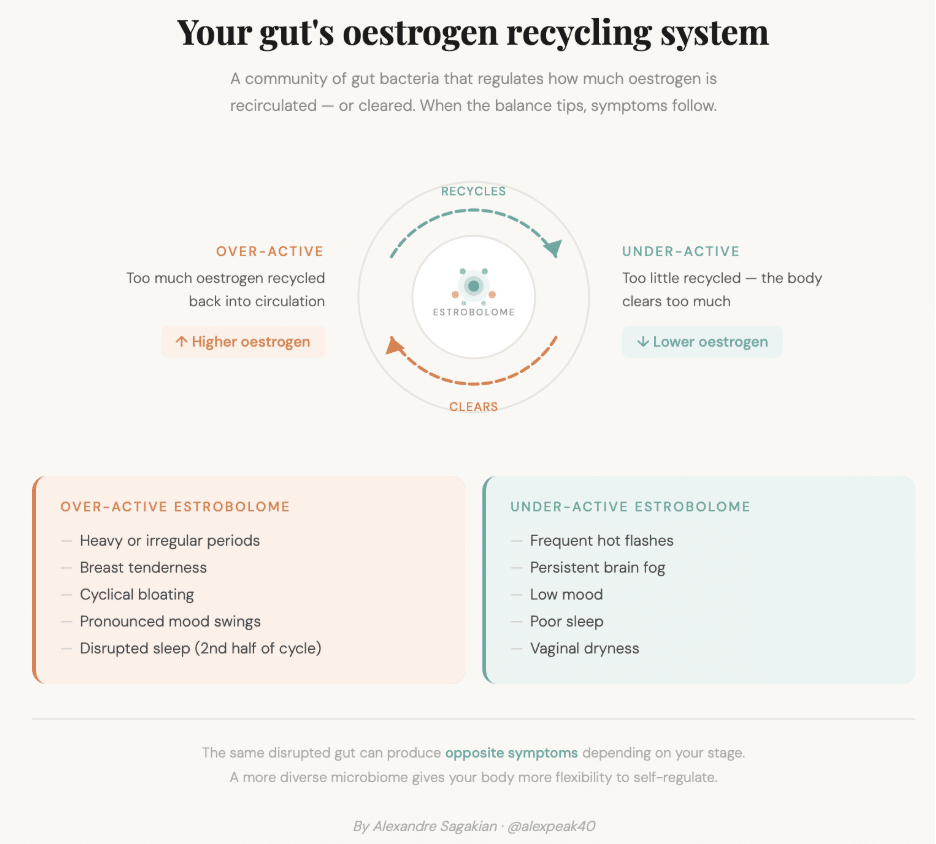
Inside your gut microbiome is a specific community of bacteria called the estrobolome. Their job is to process oestrogen – deciding how much gets recycled back into circulation and how much gets cleared out of your body. When this community is healthy and diverse, oestrogen levels stay relatively stable. When it’s disrupted – by a poor diet, chronic stress, antibiotics, or the hormonal fluctuations of perimenopause itself – the balance tips. And it can tip in either direction.
The estrobolome can work for or against you.
To understand why that matters, it helps to know that the estrobolome can go wrong in two opposite ways – and each produces a different picture. Understanding which one applies to you changes everything about the approach.
-
When the estrobolome recycles too much
If the bacteria responsible for processing oestrogen are overactive, too much oestrogen gets reintroduced into circulation. In the early stages of perimenopause, when oestrogen levels are already fluctuating erratically, this surplus can amplify certain symptoms: heavy or irregular periods, breast tenderness, cyclical bloating, pronounced mood swings, or sleep that deteriorates in the second half of your cycle. It can also worsen conditions that are oestrogen-sensitive, like fibroids or endometriosis. This isn’t oestrogen dominance in the dramatic clinical sense – it’s a subtler imbalance, but one that can make an already turbulent hormonal period feel significantly harder to manage.
-
When the estrobolome doesn’t recycle enough
On the other end, when gut bacteria are depleted – through chronic stress, repeated antibiotics, a low-fibre diet, or simply the microbial decline that comes with perimenopause itself – oestrogen clears too quickly. The body loses more than it should. This tends to show up as the more classic deficiency symptoms: frequent hot flashes, persistent brain fog, low mood, poor sleep, vaginal dryness, and a general sense of depletion that feels disproportionate to what’s happening in your life. Women in this group are sometimes told their hormone levels look « normal » on paper, yet feel anything but.
-
Why this matters for where you are in the journey
The same disrupted gut can produce completely different symptoms depending on your stage. A woman in her early 40s with an overactive estrobolome and a woman in her early 50s with a depleted one may both describe feeling « hormonal » – but what’s happening underneath is almost the opposite. This is partly why a blanket approach (« just take probiotics, » « eat more soy ») so often misses the mark. The gut-hormone relationship is directional, and the direction shifts as you move through perimenopause toward menopause. What the research does consistently support is this: a more diverse, well-nourished microbiome gives your body more flexibility to self-regulate – whichever end of the spectrum you’re currently on.
One more system worth mentioning
And if you’ve been told your thyroid looks fine on tests but you still feel exhausted, your gut may be part of the reason too. The gut appears to influence thyroid function indirectly — through nutrient absorption, inflammation, and how certain medications are processed – though this is not a substitute for proper thyroid testing if you have symptoms.
Which brings us to the most encouraging part: the gut is one of the most responsive systems in the body. It’s not fixed. The habits that support it are, for the most part, straightforward. And many women notice a real shift within weeks of making targeted changes. But the right changes depend on where you are in the journey.
That’s what we’ll cover in Part 2: What to actually do – gut health habits by menopause stage.
Alexandre Sagakian @alexkpeakhealth
About the author
Alexandre Sagakian (@alexpeakhealth) is a London-based ISSA-certified nutrition coach specialising in gut health, longevity, and sports performance. He just launched an online course, Master Your Gut for Better Digestion, Immunity & Mood, which covers the science and practical habits behind a healthier microbiome – from diet, sleep, stress, sports and supplements.


